
Antioxidant and Cell Membrane-Stabilizing Effects of Citicoline
Stroke is a major cause of adult disability and mortality worldwide, with ischemic stroke accounting for over 90% of cases.
When cerebral blood flow is interrupted, intense oxidative stress ensues, with massive free radical production damaging neuronal cell membranes and triggering irreversible neuronal injury.
In the field of stroke rehabilitation and prevention, citicoline has emerged as a neuroprotective agent of considerable interest.
Recent clinical studies have confirmed that citicoline-based compound formulations containing antioxidant components can mitigate brain injury through two primary pathways—stabilizing cell membranes and inhibiting lipid peroxidation—thereby providing protection for cerebrovascular health.
The main structural framework of neuronal cell membranes is phospholipids, and citicoline, as an endogenous precursor for phosphatidylcholine synthesis in the human body, serves as the core raw material for cell membrane repair.
During cerebral ischemia, cellular energy supply is disrupted, phospholipases are massively activated, and cell membrane phospholipids are aggressively broken down, releasing arachidonic acid (AA).
Free arachidonic acid acts as a “fuse” for oxidative damage;
under direct free radical attack, it undergoes non-enzymatic lipid peroxidation, generating 8-isoprostaglandin F₂α (8-iso-PGF₂α)—one of the most commonly used lipid peroxidation biomarkers.
This substance constricts blood vessels, activates platelets, and damages vascular endothelium, amplifying cerebral inflammation and ischemic injury, thereby creating a vicious cycle of “ischemia → membrane damage → aggravated oxidation.”
Stabilizing Cell Membranes and Reducing Oxidative Substrate Release
Citicoline helps break this vicious cycle. On one hand, as a choline donor, it accelerates cell membrane phospholipid synthesis to fill in damaged membrane structures, thereby reducing phospholipase-mediated breakdown of membrane phospholipids and decreasing arachidonic acid release at the source.
On the other hand, intact cell membranes can sequester unsaturated fatty acids, reducing opportunities for free radicals to contact their substrates and thereby decreasing lipid peroxide generation.
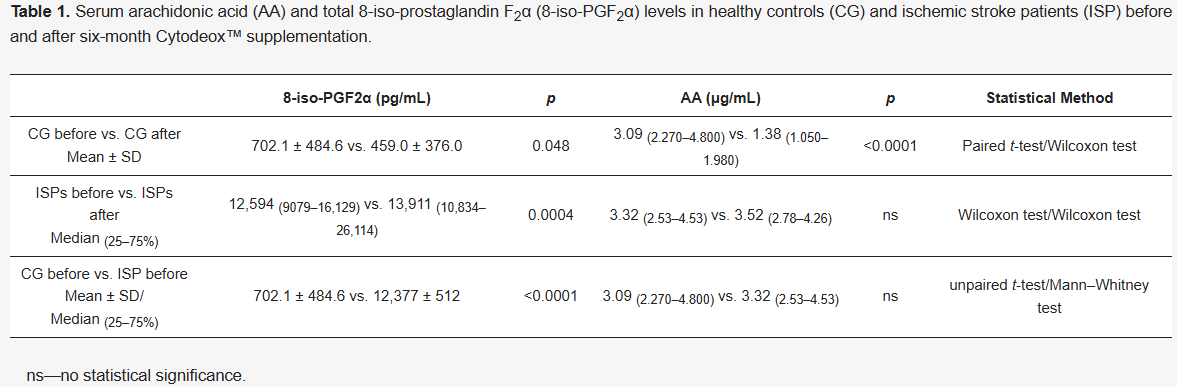
In a 6-month clinical intervention trial, healthy individuals taking a compound supplement containing citicoline showed significant decreases in serum arachidonic acid and 8-iso-PGF₂α levels, providing direct evidence of citicoline's ability to stabilize cell membranes and reduce oxidative substrate release.
Enhancing Endogenous Antioxidant Capacity
Beyond repairing cell membranes, citicoline may also enhance the body's antioxidant capacity by modulating SIRT1-related expression.
SIRT1 is an NAD⁺-dependent deacetylase and a crucial protein regulating cellular antioxidant defenses, inflammation, and energy metabolism.
It clears oxidatively damaged proteins, stabilizes mitochondrial function, and protects against the oxidative pressure brought by ischemia.
After cerebral ischemia, the human body compensatorily increases SIRT1 expression, and citicoline can further upregulate SIRT1 gene expression in peripheral blood, activating the cell's own antioxidant defense system.
In healthy individuals with balanced oxidative homeostasis, citicoline supplementation does not excessively activate stress pathways;
however, in ischemic stroke patients, SIRT1 expression is significantly elevated after administration, mobilizing cellular self-protection mechanisms and alleviating the sustained oxidative stress damage to brain cells.
Antioxidant Effects Influenced by Basal Metabolic Status
Notably, the antioxidant effects of citicoline are influenced by the individual's basal metabolic status.
For ischemic stroke patients without comorbidities such as hypertension or diabetes, citicoline combined with vitamin C, green tea, and Aronia melanocarpa (black chokeberry) polyphenols demonstrates prominent lipid-regulating and antioxidant effects, with significant reductions in total cholesterol and downward trends in lipid peroxidation markers.
However, in stroke patients with comorbid diabetes, the body's oxidative load is extremely high;
chronic hyperglycemia continuously generates massive amounts of free radicals.
Even though citicoline substantially increases SIRT1 expression, it is difficult to completely counteract the aggravated lipid peroxidation resulting from the dual damage.
This indicates that citicoline is more suitable as an early adjunctive intervention for stroke prevention in healthy populations and for mild stroke patients without metabolic complications.
At the level of daily prevention, citicoline-based compound formulations rely on a dual mechanism of cell membrane stabilization plus antioxidant action to reduce basal oxidative burden and decrease the risk of cerebrovascular damage.
With its unique dual action of cell membrane repair and antioxidant protection, citicoline establishes a two-layer protective barrier for brain cells.
It reduces oxidative substrate release at the source while simultaneously activating endogenous antioxidant pathways in the human body, demonstrating clear application value in the prevention of ischemic stroke and rehabilitation of mild cases.
Future research still requires more controlled studies to optimize dosing regimens and intervention timing, enabling citicoline to better safeguard cerebrovascular health.
References:
[1] Sokrateva T, Roussev B, Vankova D V, et al. Effects of Citicoline-Based Supplementation on Lipid Peroxidation Markers and Sirtuin-1 Expression in Ischemic Stroke[J]. Current Issues in Molecular Biology, 2026, 48(3): 314.
*Special note - This article is for informational purposes only and cannot replace a doctor's treatment diagnosis and advice. It should not be regarded as a recommendation or proof of efficacy of the medical products involved. If it involves disease diagnosis, treatment, and rehabilitation, please be sure to go to a professional medical institution to seek professional advice.

GSH Bio Tech is China Biological API Manufacturer. China Citicoline powder suppliers & best Citicoline raw material Factory.