
NMN may help protect retinal function
A new study finds that NMN may help protect retinal function.
The study, from Keio University in Tokyo and published in the International Journal of Molecular Sciences, focused on male mice given supplemental Nicotinamide Mononucleotide (NMN) after surgery to block blood flow in one of the carotid arteries.
Mice were injected with NMN daily for one week after surgery.
Experiments looking at retinal and eye function have shown that NMN treatment improves retinal function.
Additionally, NMN preserved retinal NAD+ levels, activated antioxidant genes, and reduced activation of glial cells—central nervous system (CNS) immune cells that, when activated, promote inflammation and scarring.
NMN prevents retinal dysfunction caused by vascular injury
The scientists performed carotid artery occlusion surgery on adult male mice and injected them with 500 mg/kg/day of NMN.
NMN treatment significantly reduced retinal dysfunction induced by carotid artery occlusion.
Retinal function is measured by the strength (amplitude) of the electrical waves produced by the retina in response to light.
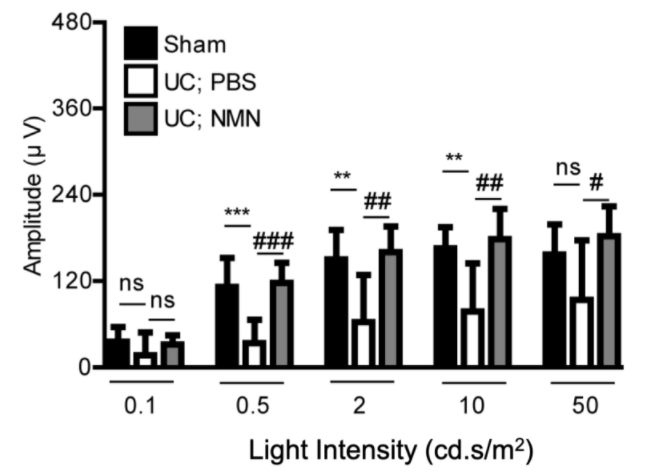
NMN preserves retinal function.
Carotid artery-occluded mice (white) show reduced amplitude of electrical waves (*) in response to increasingly brighter light (light intensity) compared with healthy mice (black), indicating retinal dysfunction.
NMN (grey) restores (#) wave amplitude and protects retinal function.
Cardiovascular dysfunction and vascular occlusion are often accompanied by oxidative stress - cellular stress caused by reactive oxygen molecules.
NAD+ has been shown to help relieve oxidative stress, and supplementing with NMN, a NAD+ precursor, has been shown to increase NAD+ levels.
NMN has also been shown to increase an antioxidant gene called Nrf2.
Glial cells support the central nervous system, including the eyes and brain.
In response to injury, glial cells are activated to aid recovery.
However, these activated cells also cause inflammation and scarring, preventing CNS tissue regeneration in the injured area.
NMN has been shown to reduce this scarring in the retina after occlusion surgery.
NMN also reduced proinflammatory glial cell signaling molecules.
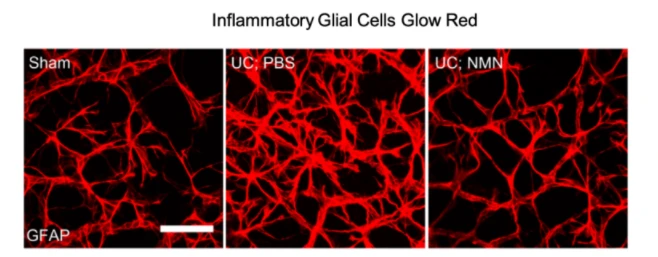
NMN prevents proinflammatory activation of glial cells.
Activated (pro-inflammatory) glial cells - which contribute to scarring - were assessed using GFAP red fluorescence.
Carotid artery occlusion mice (UC; PBS) exhibit increased retinal glial activation compared with healthy mice (Sham).
NMN (UC; NMN) reduced this activation, indicating less retinal scarring.
Can NMN help protect vision after injury?
Studies have shown that NMN helps reduce retinal dysfunction caused by carotid artery occlusion.
This study shows that NMN can have a positive effect on the eyes of patients with cardiac dysfunction and retinal ischemia, possibly in part due to its antioxidant effects.
Other studies have shown that NMN can prevent and protect retinal damage in other retina-related injuries and diseases such as glaucoma, age-related macular degeneration, retinal ischemia, and degenerative retinal detachment, further suggesting that NMN supplementation may help protect retinal function.
Previous: NMN and nervous system improvement
Next: federal court issued a final ruling halting enforcement against NMN

GSH Bio Tech is China Biological API Manufacturer. China NMN powder suppliers & best NMN raw material Factory.